

DarkSpectre
Hidden in Plain Sight: How the DarkSpectre Malware Campaign Weaponized Our Browsers


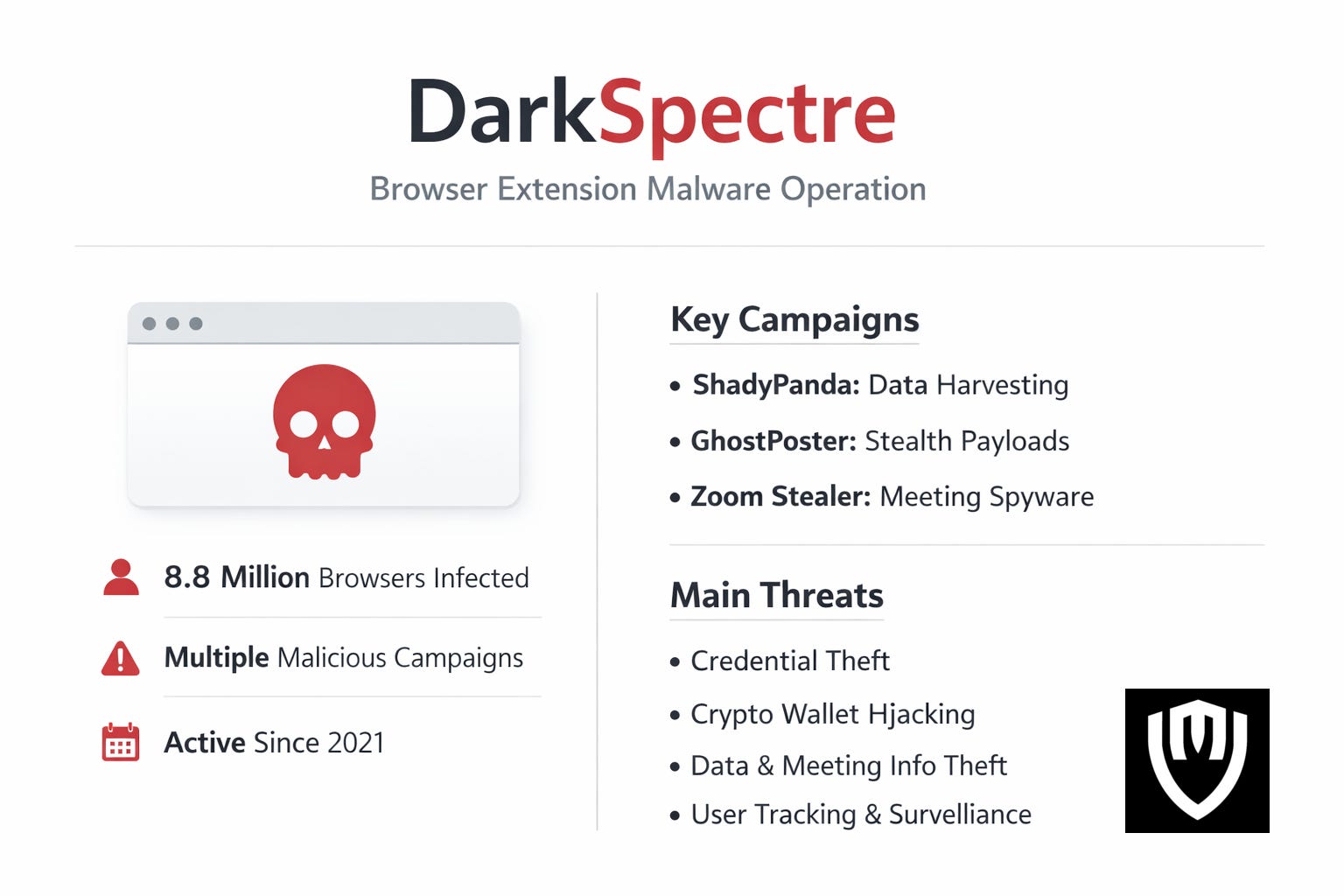
When we think about cyber threats affecting everyday internet users, our minds usually jump to dramatic scenarios: a panicked click on a sketchy phishing email, or a sudden ransomware screen locking down a hard drive.
But some of the most insidius cyber operations don’t rely on flashy malware files at all. Instead, they hitch a ride on the tools we already use and trust.
Enter DarkSpectre—a highly sophisticated threat actor behind a massive browser extension malware operation that quietly infected an estimated 8.8 million users worldwide.
Spanning across Google Chrome, Microsoft Edge, Mozilla Firefox, and Opera, DarkSpectre highlights a dangerous reality: the simple add-ons we use to customize our web experience can easily be turned into powerful cyber weapons.
The Perfect Hiding Place: Abusing Browser Trust
At its core, DarkSpectre capitalizes on a universal habit: downloading browser extensions for extra convenience. Whether it’s a custom new-tab page, a video downloader, a translation widget, or a productivity tool, millions of us install these mini-programs without a second thought.
What makes DarkSpectre uniquely dangerous is its patience and strategic planning. Security researchers at Koi Security discovered that the threat actor didn’t just launch sudden attacks; they maintained dozens of seemingly legitimate extensions for years.
The “Sleeper Agent” Method
The Clean Entry: The extensions were uploaded to official marketplaces with clean, harmless code. They passed automated security reviews, earned positive user ratings, and built up a massive install base.
The Delayed Trigger: Once safely nestled inside millions of browsers, the extensions “flipped” to malicious mode. This was done using timed delays or specific server-side triggers.
Evading Vetting: Because the initial behavior looked completely benign, standard marketplace vetting failed to flag them, allowing the malware to operate undetected for years.
Watch Summary Video Below: ⬇️
