

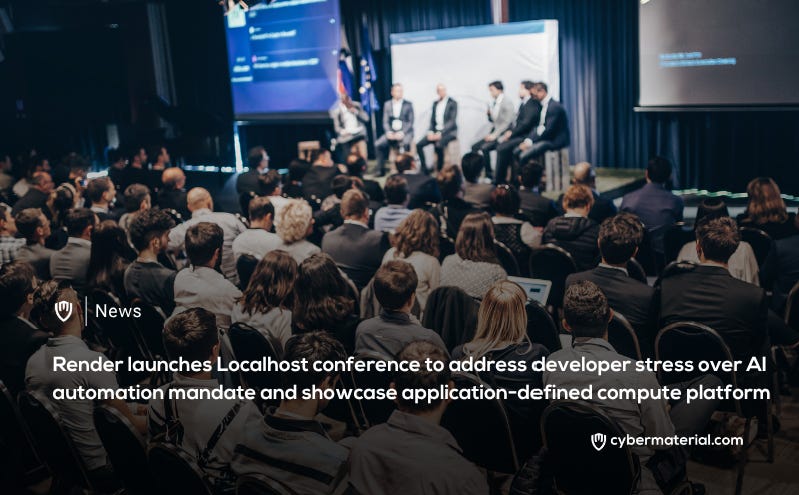
Cloud infrastructure company Render hosted its inaugural Localhost developer conference in San Francisco, targeting engineers building AI-powered applications. The event drew developers grappling with the rapid evolution of AI tooling and terminology, with attendees expressing both excitement and uncertainty about the pace of change in the industry. One recent computer engineering graduate noted the constant emergence of new concepts like "harness engineering" and "loop engineering," making it difficult to build deep expertise.
Render founder and CEO Anurag Goel presented company metrics showing 400,000 developers joining monthly, 10 million live services, and 200 billion monthly requests. Despite this growth, the company faces a perception challenge, as enterprise customers typically expect services to run on major cloud providers like AWS, Azure, or Google Cloud rather than lesser-known alternatives.
Goel argued that AI applications represent a fundamental shift from traditional infrastructure patterns. Unlike conventional applications with static resource requirements, AI-powered systems dynamically provision their own infrastructure based on runtime needs. For example, a research agent might require minimal resources for one query but need a headless browser with 128 GB of RAM for another, with task durations varying significantly. A single request can trigger hundreds or thousands of different tasks that cannot be predicted in advance.
According to Goel, existing serverless platforms cannot accommodate these dynamic requirements due to limitations on execution time, memory, storage, and application size. These constraints make them unsuitable for AI workloads that need flexible resource allocation based on unpredictable runtime demands.
Render's proposed solution is "application-defined compute," which allows applications to specify infrastructure requirements at runtime rather than pre-provisioning resources. This approach aims to provide the flexibility AI applications need while maintaining appropriate guardrails. The company positions this capability as a key differentiator for developers building AI-native applications that require dynamic resource allocation beyond what traditional cloud platforms offer.
Source: https://www.theregister.com/ai-and-ml/2026/06/19/devs-in-the-trenches-are-stressed-from-the-mandate-to-automate-everything-but-render-thinks-it-can-help/5258595