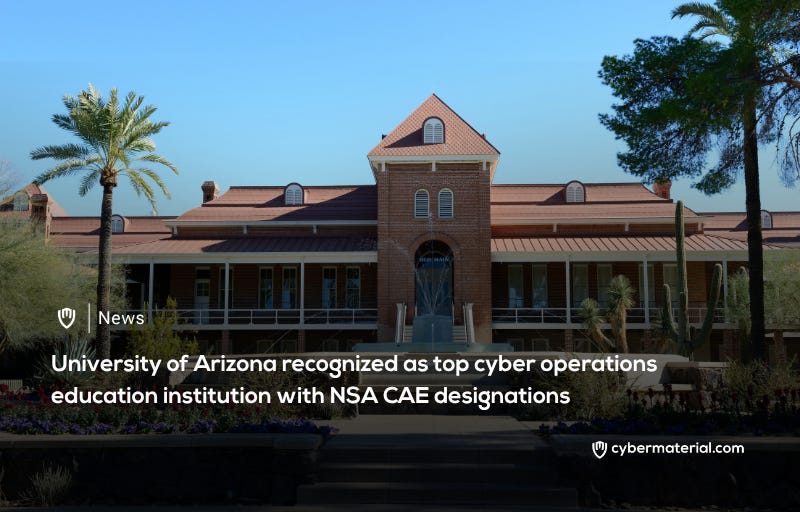
The University of Arizona has established itself as a national leader in cybersecurity education, becoming one of only 10 institutions nationwide to hold all three National Security Agency Center of Academic Excellence designations in cyber defense, cyber operations, and cyber research. The Chronicle of Higher Education recently ranked the university second in the nation for military bachelor's degrees, with 147 of 196 military-affiliated degrees awarded in 2025 focused on cyber operations. The programs span multiple colleges, with the Eller College of Management maintaining the master's degree programs and the College of Information Science overseeing the bachelor of applied science degree, which Programs.com ranks as the nation's top cybersecurity bachelor's degree program.
The university recently expanded its offerings to include a new Bachelor of Science in Cyber Operations with emphasis areas in security and cyberAI. These programs equip students with technical skills in reverse engineering, network analysis, penetration testing, and programming, preparing them for careers in a field where the U.S. Bureau of Labor Statistics projects 33% employment growth for information security analysts by 2033. What distinguishes these programs is a faculty composed largely of active practitioners from the Department of War, national laboratories, and private industry, providing students with current, real-world perspectives on cybersecurity challenges.
The programs attract students with diverse backgrounds and military connections. Veronika Kyles, who grew up near Fort Huachuca and participated in the CyberPatriot competition in middle school, completed her bachelor's degree in cyber operations and interned at the Cybersecurity and Infrastructure Security Agency's National Risk Management Center, where she worked on risk analysis for critical infrastructure including water sector industrial control systems. Abel Macias, an Air Force reservist who served at U.S. European Command during the COVID-19 pandemic, experienced firsthand the challenges of rapidly scaling secure systems when thousands of users suddenly needed remote access to networks designed for far fewer connections.
The hands-on nature of the programs provides students with practical experience addressing real security challenges. Brandon Saari, who transitioned from environmental science to cybersecurity while serving at Davis-Monthan Air Force Base, entered the program with no programming background and now builds tools for service members. His capstone project through the Arizona Cybersecurity Clinic examined how organizations integrate artificial intelligence into their systems, highlighting the human challenge of ensuring personnel understand new AI tools well enough to use them securely.
Paul Wagner, a professor at the College of Information Science and director of the Arizona Cybersecurity Clinic, notes that students gain not only technical expertise but also professional skills for communicating with both technical and non-technical audiences, along with professional networks connecting them to agencies, bases, and laboratories nationally. The programs serve a critical need as aging infrastructure systems, many built decades ago, face modern cyberattack threats they were never designed to withstand, requiring a new generation of professionals who can move critical systems from functional status to sustainable resilience.
Source: https://research.arizona.edu/news/classroom-command-u-leads-cyber-operations-education


