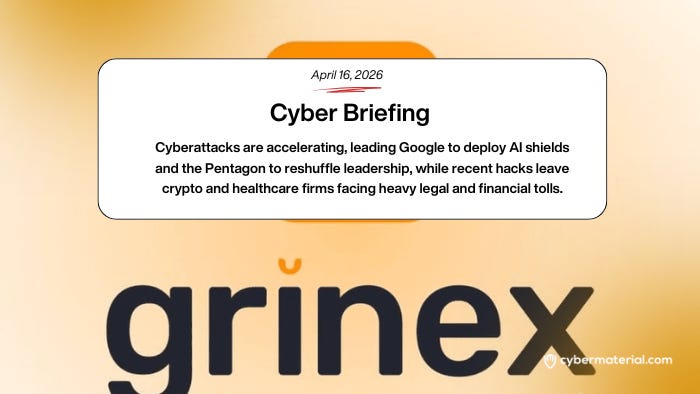
Cyber Briefing: 2026.04.17
Today’s cyber briefing landscape is marked by high-velocity exploitation and a shifting regulatory environment
Welcome to Cyber Briefing, your daily source for all things cybersecurity. We bring you the latest advisories, alerts, incidents, and news every weekday.
Today’s cyber briefing landscape is marked by high-velocity exploitation and a shifting regulatory environment. Critical vulnerabilities in Microsoft Defender and Apache ActiveMQ are being actively weaponized, with the latter exposing a 13-year-old flaw to modern RCE attacks, while North Korean state actors like Sapphire Sleet are bypassing macOS defenses through social engineering. In response, Google is leveraging Gemini AI to intercept hundreds of millions of malicious ads, and the Pentagon has overhauled its CIO leadership to accelerate digital modernization. However, the consequences of past lapses remain high: senior care providers are grappling with data leaks from 2025 ransomware attacks, the Grinex exchange has collapsed under a $14M hack, and Circle is facing a landmark class-action lawsuit that could redefine the legal obligations of stablecoin issuers to freeze stolen assets
First time seeing this? Please Subscribe
Listen to our podcast here ⏬
⚡THREAT LANDSCAPE
From tightening IoT defaults to precision targeting of the logistics sector, staying ahead of evolving attack vectors is essential for maintaining a resilient defense.
Stay informed on the latest security vulnerabilities and active campaigns targeting enterprise and personal systems.
Microsoft Defender Zero-Days Exploited
Security researchers have disclosed two critical zero-day vulnerabilities in Microsoft Defender, including an elevation-of-privilege flaw (CVE-2026-33825) nicknamed “BlueHammer.” This vulnerability allows local attackers to gain SYSTEM-level access by exploiting a race condition during the signature update process. While patches were released in the April 2026 update cycle, organizations must ensure their Defender Antimalware Platform is updated to version 4.18.26050.3011 or higher to mitigate risk. Read More
CISA Flags Apache ActiveMQ Flaw
CISA has added a high-severity code injection vulnerability (CVE-2026-34197) affecting Apache ActiveMQ to its Known Exploited Vulnerabilities (KEV) catalog. The flaw, which resided in the codebase for 13 years, allows authenticated attackers to execute arbitrary code and can be chained with older vulnerabilities to achieve unauthenticated remote access. Administrators are urged to update to versions 5.19.5 or 6.2.3 immediately to block ongoing exploitation attempts. Read More
Fake Zoom SDK Update Spreads Sapphire Sleet Malware
The North Korean threat group Sapphire Sleet is targeting macOS users with a sophisticated social engineering campaign disguised as a “Zoom SDK Update.” By tricking users into manually executing a malicious AppleScript (.scpt), the attackers bypass macOS security features like Gatekeeper and TCC to steal credentials and cryptocurrency assets. Users should treat unexpected update prompts with extreme caution and only download software from verified, official sources. Read More
🚨INCIDENTS & REAL-WORLD IMPACT
Two Senior Care Providers Hit by Ransomware
Windward Life Care (California) and Legend Senior Living (Kansas) have begun notifying over 37,000 individuals of data breaches following ransomware attacks that occurred in late 2025. The Sinobi and Worldleaks threat groups have claimed responsibility, exfiltrating and subsequently leaking highly sensitive data—including Social Security numbers, medical records, and passport information—after the providers reportedly refused to pay ransom demands. Both organizations are now providing affected residents and employees with 12 months of credit monitoring and identity theft protection services. Read More
Grinex Suspends Trading After $14M Hack
Sanctioned cryptocurrency exchange Grinex has halted all operations following a “large-scale” cyberattack that resulted in the theft of more than 1 billion Russian rubles ($13.1 million). The exchange, which is heavily linked to the Russian crypto ecosystem, attributed the breach to “special services” of “unfriendly states” and reported that funds were drained from 54 separate wallets. Blockchain analytics suggest the stolen assets were quickly converted from USDT to TRX and ETH to avoid being frozen, marking one of the most significant targeted hits on a sanctioned exchange to date. Read More
🔓 EXECUTIVE RISK & CYBERNOMICS
Insights into the evolving economic impact of AI on global advertising integrity and the accelerated pace of vulnerability exploitation.
Google Blocks 602 Million Scam Ads
In its newly released 2025 Ads Safety Report, Google revealed that its Gemini AI models successfully neutralized 602 million scam-related advertisements and suspended 4 million associated accounts. The integration of generative AI into Google’s safety systems allowed for a “99% catch rate” before ads ever reached users, analyzing hundreds of billions of signals to identify malicious intent rather than just keywords. This proactive defense is critical as bad actors increasingly use their own AI tools to generate deceptive content at an industrial scale. Read More
FIRST CEO Calls for CVE Collaboration
Chris Gibson, CEO of the global incident response alliance FIRST, is sounding the alarm on a drastic shift in the threat landscape: the “mean time to exploit” has plummeted from weeks to mere hours. Speaking at the VulnCon 2026 summit, Gibson emphasized that AI-driven weaponization of flaws necessitates a unified global response, praising ENISA’s recent integration with CISA and MITRE. To stabilize the ecosystem, Gibson advocates for bringing major AI firms into the fold as CVE Numbering Authorities (CNAs) to ensure autonomous models don’t outpace traditional disclosure cycles. Read More
🛡️ POLICY, REGULATION & LEGAL SIGNALS
Updates on judicial outcomes for cybercriminals and emerging legal precedents regarding the liability of financial platforms in asset recovery.
DraftKings Hacker Sentenced to Prison
Kamerin Stokes, a 23-year-old operating under the alias “TheMFNPlug,” has been sentenced to 30 months in prison for his role in a 2022 credential stuffing attack that compromised 60,000 DraftKings accounts. Notably, Stokes continued to operate his illegal “shop” and sell stolen credentials even after pleading guilty in 2024, reportedly telling customers he needed to “pay his attorneys.” In addition to his prison term, the court ordered Stokes to pay $1.3 million in restitution to the victims of the breach. Read More
Circle Faces Lawsuit Over Stolen USDC
Stablecoin issuer Circle is the target of a class-action lawsuit following the $280 million exploit of the Solana-based Drift Protocol on April 1, 2026. The complaint, led by investor Joshua McCollum, alleges that Circle was negligent in failing to freeze approximately **$230 million in stolen USDC** as it was bridged to Ethereum over a six-hour period. The plaintiffs point to a “double standard,” noting that Circle had successfully frozen 16 wallets in an unrelated civil case just days prior, proving they possessed the technical capability to intervene. Read More
💻 CAREER ENABLEMENT
Pentagon Announces New CIO Office Appointments
The Department of Defense (DoD) has strategically restructured its Office of the Chief Information Officer (OCIO) with four key leadership appointments aimed at accelerating the “Department-wide Digital Modernization” initiative. The new leadership team, comprised of Kayla Huthoefer Nelson, Marci McCarthy, Ryan McArthur, and David Vaughn—will oversee critical portfolios including external industry engagement and the scaling of secure data infrastructure for Joint All-Domain Command and Control (JADC2). These roles are pivotal as the Pentagon pivots toward AI-ready systems and seeks to bridge the gap between commercial tech innovation and frontline military operations. Read More
Copyright © 2026 CyberMaterial. All Rights Reserved.
Follow CyberMaterial on:
Substack, LinkedIn, Twitter, Reddit, Instagram, Facebook, YouTube, and Medium