

Cyber Briefing: 2026.07.17
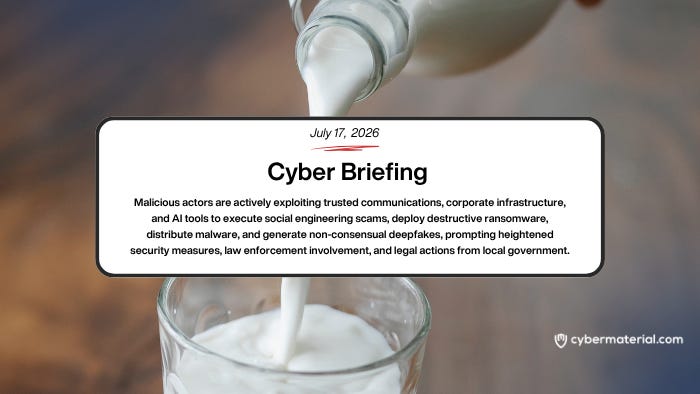
Generative AI scams, rapid-fire ransomware, and non-consensual deepfakes: The tactical shift driving aggressive new law enforcement and local government intervention.

Welcome to Cyber Briefing, your daily source for all things cybersecurity. We bring you the latest advisories, alerts, incidents, and news every weekday.
Cybercriminals are increasingly leveraging trusted platforms and advanced technologies to target both individuals and organizations. Apple has warned that scammers are spoofing caller IDs on FaceTime to impersonate trusted representatives and steal credentials, while attackers on GitHub are creating fake repositories that mimic legitimate brands like LastPass to distribute malware. On the technological front, San Francisco’s City Attorney has issued cease-and-desist letters to Apple and Google demanding the removal of 13 AI-powered “nudify” apps that create non-consensual deepfake images. Conversely, 1Password has launched a secure beta integration with Anthropic’s Claude AI, allowing the assistant to authenticate website logins on behalf of users without exposing their actual passwords.
Simultaneously, severe cyber incidents continue to disrupt the healthcare and manufacturing sectors. In healthcare, All About Women’s Care in Colorado suffered a breach affecting 12,000 patients via stolen VPN credentials, while Mid-South Pulmonary Sleep Specialists in Tennessee fell victim to a ransomware attack by the Anubis group. Meanwhile, a major ransomware attack on Coca-Cola’s Fairlife dairy subsidiary forced a complete production halt across all of its US plants, triggering incident response protocols and an active law enforcement investigation into the full material impact.
Listen to our podcast here ⏬

⚡THREAT LANDSCAPE
Scammers weaponize FaceTime for social engineering
Apple has issued a warning that scammers are exploiting FaceTime calls to conduct social engineering attacks against iPhone and iPad users. Attackers impersonate representatives from trusted organizations and use caller ID spoofing to appear legitimate, tricking victims into revealing login credentials, security codes, and financial information. Users should verify caller identities through official channels before sharing any sensitive data and remember that legitimate companies will never request passwords or security codes through unsolicited calls. Read More

🚨INCIDENTS & REAL-WORLD IMPACT
Women’s Care & Pulmonary Sleep Breaches
All About Women’s Care in Colorado disclosed a breach affecting 12,000 patients after an attacker used stolen VPN credentials to access files containing names, Social Security numbers, medical records, and ultrasound images. Mid-South Pulmonary Sleep Specialists in Tennessee suffered a November 2025 ransomware attack by the Anubis group, exposing patient data including financial information, medical histories, and insurance details. Both practices have engaged cybersecurity experts and are reviewing security policies while notifying affected patients. Read More
Ransomware halts Fairlife dairy production
Coca-Cola’s Fairlife dairy subsidiary has halted production at all US plants following a ransomware attack that compromised production-related systems. The company detected unauthorized access to its systems and immediately activated incident response protocols, engaged external cybersecurity experts, and notified law enforcement. Canadian facilities remain operational, and Coca-Cola states product quality and safety have not been affected, though the full scope and material impact are still under investigation. Read More

🔓 EXECUTIVE RISK & CYBERNOMICS
1Password integrates with Claude AI for secure authenticatio
1Password has launched a beta integration with Anthropic’s Claude AI assistant that allows the AI to authenticate to websites on behalf of users without exposing passwords or credentials. The feature is available to paid Claude subscribers (Pro, Max, Team, and Enterprise) using Claude Desktop on macOS, and requires 1Password customers to have the desktop app and browser extension installed. This integration enables Claude to complete browser-based tasks requiring login while maintaining security by keeping sensitive credentials isolated from the AI system. Read More

🛡️ POLICY, REGULATION & LEGAL SIGNALS
San Francisco demands Apple, Google remove AI nudify apps
San Francisco’s City Attorney sent cease-and-desist letters to Apple and Google demanding removal of 13 AI-powered apps that create non-consensual nude images, primarily targeting women and girls. The apps use face-swapping technology to generate explicit deepfake content, and the city argues the tech companies profit from distributing these tools. Both app stores are being told to immediately stop hosting these applications or face potential legal action. Read More
💻 CAREER ENABLEMENT
How to use GitHub safely
Cybercriminals are increasingly abusing GitHub to distribute malware by creating fake repositories that impersonate legitimate brands like Malwarebytes and LastPass, targeting users who download software through search results or forum recommendations. GitHub does not vet uploaded code, making it easy for attackers to create convincing pages with fake engagement metrics and polished documentation. Users should verify repository authenticity by checking account age and official sources, avoid downloading executables from unfamiliar links, and never ignore security warnings from browsers or antivirus software. Read More

Copyright © 2026 CyberMaterial. All Rights Reserved.
Follow CyberMaterial on:
Substack, LinkedIn, Twitter, Reddit, Instagram, Facebook, YouTube, and Medium